Document Storage for the Legal Industry

Document storage for the legal industry

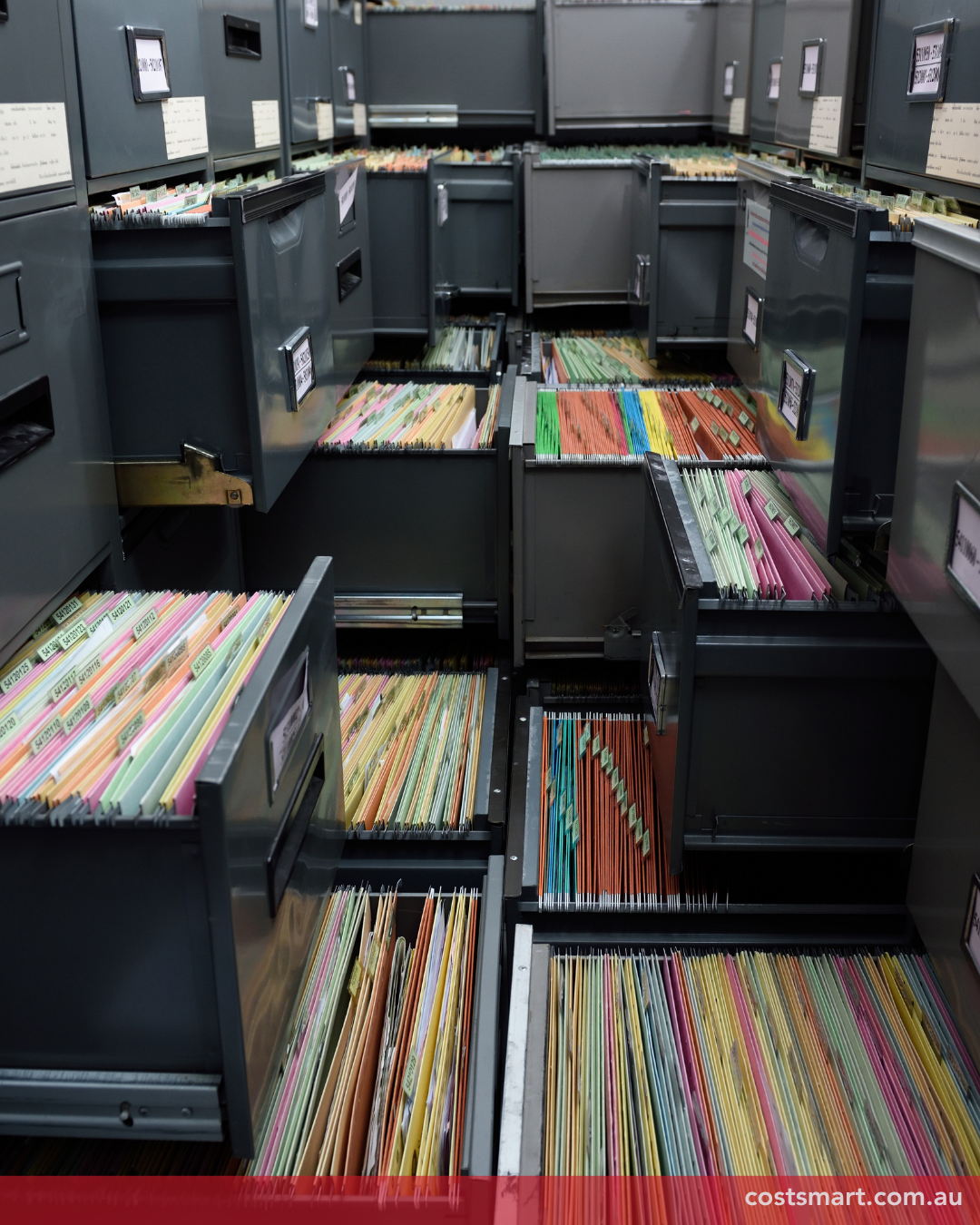
A legal firm is responsible for managing an overwhelming number of documents. Lawyers and legal staff work with an array of legal documents every day, including notes, contracts, reports, notices and much more. A 2013 article by The Australian Legal Sector Alliance suggested that a person working within an Australian law firm uses approximately 125 kg or 25,000 sheets of paper per year. Due to the nature of the legal industry, we would assume a large percentage of these printed documents will need to be stored for compliance requirements. Responsible document storage and management for the legal industry is therefore of noteworthy importance to ensure that a legal firm is not reprimanded for malpractice or negligence after mishandling documents.

Ownership of documents in a law firm

While the storing of physical documents and records is a necessary responsibility for law firms, physical storage comes with several challenges. In New South Wales the rules regarding document storage and handling depend on several circumstances relating to ownership. Most legal documents belong to the client, with some belonging to the lawyer. Documents that are considered to belong to the lawyer include:

How long does a law firm have to keep client documents?

A law firm can destroy most client documents in their possession after 7 years from the completion or termination of the job, except where there are client instructions or other legislation that instructs otherwise. To add to the complexity of document storage and management, even after 7 years the destruction of client documents can not be performed without the client’s consent. As you can see, there are a lot of intricacies around document storage and management of legal documents.

For a law firm to manage their document storage and destruction internally is not only expensive but can occupy a huge amount of floor space. There may be the consideration to scan and electronically store document files, but this is certainly not the most cost-effective solution available – as noted in our previous post Document File Storage Cost vs Scanning Cost. Outsourcing Document Storage and Management to an offsite service provider, such as CostSmart, is therefore recommended because it reduces disciplinary action due to following compliance requirements, helps save money and space on storage and ensures security by preventing unauthorised access. CostSmart can manage a legal firm’s retention and destruction rates based on specific needs, ensuring that documents are successfully destroyed according to schedule and compliance.

Safe Storage

While there is no direct legislation in place for the legal industry as to what exact precautions need to be in place to keep documents safe, it is evident that protection against reasonably foreseeable threats is a must – including theft (by public or staff), fire and flood. CostSmart’s secure facilities include two 11-metre firewalls, an onsite fire hydrant and booster, systematic replacement of shelving with wire meshing and all fire safety aspects are inspected, pressure tested and regulated by qualified third-party professionals. CostSmart has elevated warehouse shelving in the event of localised road flooding, ventilation, security cameras operating 24/7 and an alarm system for fire and theft. With many law firms operating in expensive urban centres, offsite document storage and management makes way for a secure, cost-effective and efficient option that frees up precious office floor space for other pressing purposes.

Scan On Demand

CostSmart’s Scan on Demand service is our recommended service for law firms. The Scan on Demand service bypasses the need for couriering, saving on time and the potential cost of shipment. We retrieve your document and deliver it to you via a secure electronic file transfer protocol within 2 hours of your request. The document is then returned to its original location in our warehouse. This pay-as-you-go service is the most cost-effective service in the market. Especially if CostSmart manages your destruction dates, which as explained above, is generally 7 years for the legal industry.

To find out more about CostSmart’s document storage and management solutions for law firms, get in touch with us at mark@costsmart.com.au or by calling 1300 100 461 for further information. Our team would be happy to discuss a personalised approach for your firm.


A Quick Guide to Document Retention Regulations

Another financial year has come and passed, and with it brings the necessity to begin storing and retaining important documents. Whether these are financial records for tax purposes, GST records, company documents, client documents or personnel files, we will provide you with a summary breakdown of the mandatory minimum document retention requirements for you.

Document retention may not be the most exciting component of conducting business, however, it is of significant importance in order to ensure that a business is not reprimanded or sued for mishandling or destroying mandatory documents.

Implementing a document retention plan/policy that involves outsourcing document storage is recommended because it helps companies save money on storage, reduces litigation risks by following Government rules and regulations and ensures security by preventing unauthorised access.

Here is our quick guide to document retention regulation in NSW:


Please note: This is intended as a guide only. For comprehensive information regarding document retention requirements, contact the regulatory body responsible for your industry and head to the ASIC and Australian Government: Business websites for more information.

You can see from the table provided that there is a vast array of documents that require storage in order to satisfy legal retention requirements. A company may consider keeping files indefinitely to ensure they cover all bases, however, the logistics and cost of doing this would be a substantial burden. For a company to manage their document retention internally is not only expensive but can occupy a huge amount of floor space. There may be the consideration to scan and electronically store document files, but this is certainly not the most cost-effective solution available – as noted in our previous post Document File Storage Cost vs Scanning Cost.

Outsourcing document file storage to a Records Management, Business and Document Storage provider such as CostSmart can free up valuable space in a company’s own premises and gain greater control over inventory. CostSmart offers streamlined document storage and records management for efficient processing and access for our customers. CostSmart can provide three different services relating to document file storage: physical document storage, scanning and ‘Scan on Demand’. CostSmart can also manage your destruction rates, which means one less logistic your company has to think about.

To find out more, get in touch with our team at mark@costsmart.com.au or by calling 1300 100 461 for further information. Our team would be happy to discuss a personalised approach for your business


Document File Storage vs Scanning

What is Document File Storage?

Document file storage involves storing physical documents in-house or with a document file storage service supplier, such as CostSmart. These files are then retained in accordance with record retention guidelines and retrieved when a company requires them.

What is document scanning?

Document scanning involves the process of scanning and converting physical documents into digital format for storage via a server or ‘cloud’.

Document file storage cost vs Scanning cost

Document file storage vs ScanningThere are many factors to consider when deciding whether to use a document file storage service or a document scanning service. Although, when push comes to shove, the cost of a service is often the leading factor when deciding whether to warehouse or scan important documents.

Depending on the total quantity of boxes to be stored, an archive box can cost between $0.50 – $1.20 per box per month (depending on the supplier/partner you utilise). If a company holds 500 boxes in storage, this equates to $3,000 – $7,200 per year in storage costs.

On the other hand, scanning an archive box can take 2- 4 hours depending on many variables including unravelling staples, paper size, folding etc. If a company requires 500 boxes to be scanned, and if we were to assume that labour costs were $45 per hour, this would equate to $45,000 – $90,000 in scanning costs.

Physical document file storage is evidently more cost-effective than having documents scanned and stored electronically. When considering the example above, long-term storage for 14 years is still significantly less expensive than document scanning services for 500 boxes.

However, this is not the most cost-effective service in the market. CostSmart offers a ‘Scan on demand’ service, whereby we retrieve your hard copy documents from our storage facility, scan them and send them electronically at your request, and only when you require them.


CostSmart’s ‘Scan on Demand’

CostSmart’s ‘Scan on Demand’ service bypasses the need for couriering, saving on time and the potential cost of shipment. CostSmart retrieves your document and delivers it to you via a secure electronic file transfer protocol within 2 hours of your request. The document is then returned to its original location in our warehouse. This pay-as-you-go service is the most cost-effective service in the market. Especially if CostSmart manages your destruction dates, which are generally 7 -10 years depending on your industry requirements.

To find out more about CostSmart’s ‘Scan on Demand’ solution, get in touch with us at mark@costsmart.com.au or by calling 1300 100 461 for further information. Our team would be happy to discuss a personalised approach for your business.


Can Procurement be Enhanced by External Partners?

Outsourcing the procurement of goods, services, suppliers and materials can generate major benefits for businesses of all types and sizes. Procurement outsourcing is growing, companies are becoming more aware of the benefits, the outcomes have been documented and substantiated, and these results are helping company bottom lines.

Main Benefits of Outsourcing

Procurement outsourcing is the transfer of specified key procurement activities relating to sourcing and supplier management to a third party. Businesses will sometimes do this to reduce costs or, often in the case of procurement, to add specialist skill sets to their procurement department.
Outsourced procurement significantly reduces efforts of staff who will ultimately have to oversee and assess all the intricacies within the procurement. It takes all of the burdens off their shoulders by putting a lot of the hard work into the hands of experts who specialise in this.

Why Companies are Outsourcing Procurement

Procurement is becoming increasingly seen as a process comparable to legal or IT functions in that it is better to leave it to an external party with specific expertise. Procurement outsourcing is allowing more companies to become more competitive while giving them more room and resources to focus on core business activities like growing their brand and acquiring new customers.
In many other cases, however, outsourcing procurement is more comparable to outsourcing aspects of a certain function such as HR in order to reduce operating costs and improve existing systems and processes. For example, a third party will conduct the research, analysis and comparison stages before someone internal at the company makes the final decisions on which products or suppliers to use.

How to Implement Outsourced Procurement

Implementing outsourced procurement will depend on both the size of the company and how extensive the outsourcing programme is. Large businesses with long-existing systems and processes in place looking to overhaul their procurement functions can usually expect a longer implementation period. Businesses may introduce outsourcing slowly over a sustained period of time, testing aspects of the model bit-by-bit rather than undergoing a vast transformation programme in one go.
The process may be faster for a smaller and/or newer company due to less complexities. Regardless of the type and size of the business, the right partner will have the expertise to ensure implementation is smooth, efficient and provides good value to your company.

Procurement Services by CostSmart

At CostSmart, we do the cost analysis and comparisons of various providers and suppliers for you. We can generate all of the comparisons on what these businesses offer, their main offerings, how they differentiate, what their value propositions are and their comparative price-points all to help you find the right fit.
We ultimately act as an intermediary agent, helping to streamline the entire process of researching different suppliers, generating quotes from various suppliers, comparing all the data between suppliers and making the decision on which supplier your business should ultimately choose. To find out more about how we can help please get in touch today.

The Importance of Branded Products for Your Business

Finding effective and creative ways to grow your brand awareness is essential for building your business and attracting new customers. In this digital age, many businesses understandably focus on digital marketing and social media. However, it’s important you don’t disregard the value of more traditional marketing techniques, such as the use of branded products.

Building Brand Awareness

Branded products are great for building brand awareness. They help get your company and its logo in front of as many eyes as possible. Having your logo on tangible items that are regularly used in public is an excellent way to increase visibility. Whereas other advertising promotions cost a lot of money to run and for a short amount of time, branded items are an easy way to get your brand in front of people’s eyes on a regular basis.

Depending on the type of business, some branded products you could use include reusable shopping bags, clothing, pens, mouse pads, note pads, water bottles or a calendar. The best approach is to opt for items that have an everyday use so that people will carry them around in public.

Big Reach, Low Cost

Even on a tight budget, your company can find great items that you can add your logo or name to and have an impact on your marketing and brand visibility. You can quickly and easily give them away to existing and potential customers. Branded products are a great investment for any business, and offer fantastic value for money.

You can be incredibly creative with your branded products through unique designs, which will allow you to distinguish yourself from your competitors. Branded products are also more tangible to customers than ads on radio, TV, social media, search engines and billboards, which can quickly escape from people’s minds.

Build Brand Loyalty

Brand loyalty is built over time, but branded products can quickly give you a big boost. One study by BPMA found that 73% of participants who had received a free branded gift from a business had then purchased from that company. The reason is simple – everyone loves a freebie.

It’s a well documented phenomenon that people experience happiness and pleasure when they receive an unexpected gift. These positive emotions they experience will then become associated with your business and brand. Promotional products help people remember your company and in turn, encourage them to purchase your products and services.

Procurement and Branding Services by CostSmart

CostSmart provides procurement, branding, warehousing and distribution services for businesses, allowing them to save time and cut costs through smart supply chain management. We can source, store, manage, and deliver branded items, merchandise, uniforms and workwear, equipment, promotional materials, marketing print collateral and all non-core products for your business.

Find out more about how we can help or get in touch today.

How to Efficiently Analyse and Manage Business Expenses

Procurement is a key expense for most businesses and one that rightfully gets a lot of focus in terms of how to analyse, manage and minimise the costs involved. The various processes involved in procurement are time consuming – from researching different suppliers, generating quotes from various suppliers, analysing the costs between suppliers and making the final decision on which supplier to choose. As a result, streamlining this entire process is also an important cost-saving exercise.

How to Manage Procurement Spend

Managing spend is a long process of collecting, categorising and assessing data spend habits in order to cut down on procurement costs, improve efficiency and monitor workflows. The procurement cycle also involves various other activities such as requisition processing, inventory management and sourcing.
Every business, regardless of size or type, spends extensive time and resources managing this spending. For companies looking to mitigate this massive resource and cost expenditure, procurement outsourcing is a viable solution.

What is Procurement Outsourcing?

Procurement outsourcing involves a company outsourcing their procurement functions, with the acquisition of goods and services, through a third party. This does not mean that the company loses control, but instead it utilises the support of third party services to increase efficiency.
Many businesses do not have the time and resources to efficiently deal with the various factors and processes involved in procurement. Often, it is far easier, less time-consuming and more cost-effective to engage an expert in this line of work.

Key Benefits

Companies often lack the internal staff to conduct procurement processes in a way that involves analysis and detailed cost comparisons. Many smaller companies cannot afford a purchasing department at all. They might have one person who buys for the company, so very little or no cost reduction, vendor negotiation, contracts, and price analysis take place.
Larger companies have the issue of inconsistent procurement processes because one department does not know what the other departments are doing. This leads to increased costs, inconsistencies, mistakes and inefficient goods and services management.

How CostSmart Helps

CostSmart can help companies of all sizes analyse and manage external expense costs, such as securing and comparing suppliers, ordering of items and comparing costs between various parties, acting as an intermediary agent. We can compare the costs, value propositions, service levels etc. between different suppliers to provide the best recommendation on which supplier you should choose. CostSmart can then manage external expense costs and provide the most appropriate suitors to clients.

We also provide storage and distribution services for businesses, allowing them to save time and cut costs through smart supply chain management. We can source, store, manage, and deliver everything from your own products to branded merchandise, uniforms and workwear to stock, equipment, promotional materials, marketing + print collateral, records management, archives and all non-core products for your business.

Find out more about how we can help or get in touch today.

How Covid-19 Has Changed the Offices of the Future

The pandemic has forced the adoption of new ways of working. Organisations across a range of industries have been forced to reimagine their work and the role of offices in creating safe, productive, and enjoyable jobs for employees. However, the large-scale work-from-home experiment has inspired other ways to reimagine how offices and business spaces can function in ways that benefit the efficiency of the entire operation.

Redesigning Workplaces to Support Priorities

We all have ideas of what a typical office looks and feels like. What comes to mind for most is a mixture of private offices and cubicles, with meeting rooms, pantries, and shared amenities. Few offices have been intentionally designed to support specific business priorities. After a year or more of employees working from home, organisations can now reimagine what kind of spaces they actually need.
If the primary purpose of your business office space is to accommodate specific moments of collaboration rather than individual work, for example, maybe 80 percent of the office should be devoted to collaboration rooms. Perhaps employees who rarely have to collaborate or attend group meetings can work from home.

Reimagining How Space is Used

These changes may not only improve how work is done but also lead to savings and operational efficiencies. Rent, capital costs, facilities operations, maintenance, and management make real estate the largest cost category outside of payroll for most organisations.
Businesses can transform how their workplaces function with a portfolio of space solutions, ranging from owned space, standard leases, flexible leases and co-working spaces to remote work and a suite of off-site business solutions for warehousing, storage, procurement, archiving and more.

Consider Which Spaces and Services to Outsource

Businesses should consider how they can remove unnecessary spaces and other links from the supply chain to maximise efficiencies, maintain quality and decrease costs. For example, off-site warehousing can simplify stock management and streamline the delivery of products. Sourcing and procurement specialists can utilise a vast network of suppliers to find quality non-core products for your brand.

Off-Site Warehousing by CostSmart

CostSmart provides off-site warehousing, procurement and distribution services for businesses, allowing them to save time and cut costs through smart supply chain management. We source, store, manage, and deliver all of your core or non core products. These can include merchandise, uniforms and workwear, equipment, promotional materials, marketing print collateral, office furniture, archives, records, packaging…anything for your business.
At our premises, all physical product archiving is stored on site. CostSmart will seamlessly store and manage your inventory or products and can provide full visibility over your inventory.Find out more about how we can help or get in touch today.

Why Off-site Warehousing and Fulfilment is the Future

Inventory management can be a challenge for any size company. Many start-up companies have limited space but want to offer large product lines to their customers or staff. The challenge is the cost and work involved with managing your inventory in a warehouse. Today’s consumer also expects fast shipping at a low price.

It’s safe to say that major brands like CostSmart have changed the way product fulfilment succeeds in terms of streamlining warehousing, logistics and distribution. The speed at which CostSmart and many other organisations can turn around and deliver orders has created a consumer expectation that affects every commerce business. Off-site inventory management is the perfect solution to this problem.

Cost-Effective Warehousing

The speed at which CostSmart can turn around and deliver orders has created a consumer expectation that affects every commerce business. Off-site warehousing ensures your orders are promptly and efficiently packaged and delivered with a proven SKU processing system, reducing the chance of costly mistakes and consumer and staff dissatisfaction. Inventory can be carefully monitored and analysed according to the flow of demand.

Since inventory management is the specialty of our off-site warehousing solution, we are able to engage in bulk shipping, drastically reducing the shipping costs of products. We also cut costs through methods such as C-Code Methodology. These savings are passed on to your company and to your customers!

Inventory Management Experts

Off-site warehousing provides a reliable level of control over the flow of your inventory in and out of our business, ensuring stock is managed at minimal cost. CostSmart is a reputable warehouse and distribution partner and is well equipped to handle stock, maintenance and distribution of your items because we can leverage our existing logistical pipeline to ensure your products get where they need to go.

Whether you are gathering supplies from third party vendors or storing your own excess products, utilising our off-site warehousing solution keeps everything organised and flowing correctly through the supply chain.

Focus on Other Areas of Business

Adding a warehouse to your operations is like taking on an entire second location, with all the upkeep, cost and administrative burdens that entails. By managing your inventory off site, your company won’t have to deal with all the work and expenses involved with warehousing. This frees up your time, resources and efforts to focus on core aspects of your business, such as growing your brand and attracting new customers.

Off-Site Warehousing by CostSmart

CostSmart provides off-site warehousing, procurement and distribution services for businesses, allowing them to save time and cut costs through smart supply chain management. At our premises, all physical product archiving is stored on site. CostSmart will seamlessly store and manage your inventory or products and can provide full visibility over your inventory.

Find out more about how we can help or get in touch today.

Customer Satisfaction is the Key to a Successful Partnership

At CostSmart we take pride in our relationships with our clients. Our dedicated and loyal employees have enabled us to secure lasting relationships and we are proud to still be partnering with a number of clients who have been with us since we commenced in 2004.
We recently conducted a Customer Satisfaction Survey and received some excellent feedback from our wonderful partners. Thank you to everyone for your support!

“Love the staff, always helpful, nothing is too much bother, friendly and welcoming.”

“Willing to go outside your comfort zone to provide a solution to our problem.”

“Always been a pleasure to deal with Dan and Jaymie! We’ve never had any issues and always had a great relationship.”

“Extremely reliable and a great partner to have.”

“Friendly and fast service always provided by the team. Nothing is ever too hard or unachievable.”

“Jaymie is absolutely fantastic at coming back to us regarding any request we make, no ask is too big or too small. We are often working to tight deadlines or already behind, and they always go above and beyond to ensure things are delivered in a timely manner. They are an asset to us.”

CostSmart take the time to learn about your business, your goals, and act as a true extension of your team to deliver high-end, creative solutions on time and on budget. Please contact us today to see how CostSmart can help you and your business!

Printed marketing material – printing jargon explained

Printed marketing material and visual merchandising can give your brand a space to tell its story or offer more insight into your services. Sometimes a design agency is hired to create the designs for you externally, and other times the concepts are created in-house. Either way, understanding printing principles can arm you with the knowledge to ask for the product that truly aligns with your brand. It also helps when you can provide an agent with the correct specifications from the get-go to avoid the tedious back and forth. Remember that you can always ask for samples of something you might be interested in as papers/print types/coating etc are always more accurate in person.

CostSmart’s printing professionals and partners can assist you with all your printing needs from flyers to large scale promotional signage. If you have any questions about printing techniques or whether a particular out-of-the-box design is do-able (it usually is!), then contact us on 1300100461.

IN THE MEANTIME, HERE IS A LIST OF KEY PRINTING TERMS TO ADD TO YOUR ARSENAL:
Bleed: There are two bleed types, external and internal.

External: When an illustration, background or image is extended beyond the intended edge of the page. This allows for a small amount of movement that may occur when printing is being cut to size. Standard bleed allowance is normally 3mm, but your printer or agent will alert you if it’s different. You can easily add a bleed guide to PDF’s or Adobe Creative files so you can gauge how far you need to extend the design. You might be asked for your artworks bleed size, which would be referring to the size of your artwork including the extra external bleed.

Internal: Also known as the ‘text safe’ space, the internal bleed is when text is kept a certain distance from the trim edge to avoid any chance of it affected during the cutting process. It is also usually 3mm in size.

Celloglaze: This can also be referred to as laminate. It is a protective plastic film that is heat bonded to a page for products like business cards and booklet covers. While gloss is a common finish, Celloglaze also comes in matte or velvet finish. Many business cards now lean towards a clean matte finish, plus it also is perfect for products that may need to be written on.

CMYK: You might know this one just by replacing the ink in your home printer. Cyan, Magenta, Yellow and Black are the colours of commercial printing. When designing a print product, it is important that the colours used are CMYK.

Coated Paper: This means that a small percentage of clay has been added into the surface coating of the paper to give a smoother and more even finish, with greater opacity.

Colour Mode: Just as we mentioned earlier about using CMYK when designing print products, Colour Mode refers to the colour setting used to create an artwork. CMYK is one type, as is RGB or PMS.

Crop marks: You have probably seen these little black marks in the corners of a PDF. These crop marks indicated where the artwork will be trimmed to size. Anything outside the marks will be removed. You can easily add to crop marks to a PDF before sending off to a printer.

Die-Cutting: This is a post-press finish that allows packaging and print pieces to have unique cutouts that can vary from simple to extremely detailed. Die-cutting adds a dimensional nature to the product.

Embossing/Debossing: raising and depressing aspects of your packaging gives your customers a tactile experience. Some techniques include:

Sculptured: Often hand-crafted, sculpturing involves raising or lowering features in a sharp or rounded manner. They expertly depict definition and texture in a realistic manner.

Multi-level: This finish allows for multiple angles and three-dimensional definition.

Single-level: This is the most popular and efficient finish, with just one layer of dimension.

Finish Size: This is the final size your artwork will be trimmed to.

Finishing: This could include anything that occurs after printing. Some examples could be trimming, folding, stitching, binding, or laminating.

Foil Stamping: A machine with a metal plate engraved with the desired design stamps picks up a foil and then transfers it onto the document. The result is a document that has a highly reflective image with a bright and dense metallic appearance.

Folding: This one seems straight forward, but there are so many folding options and additional folding instructions that needed to be added to an artwork. There are a plethora of folding options for your standard brochure so be sure clarify specifications before getting started on artwork or briefing a designer. Chances are if you want your brochure to be folded in a certain way, it can be done! Let us know what you have in mind and we will help you make it happen. We can also help with setting the panel orientations and the fold/score positions correctly.

Perfect Binding: This is when the cover and pages of a booklet are bound along the spine using adhesive. Be sure to enquire about glue strengths because quality does vary.

PMS (Pantone Matching System): Pantone colours can be purchased by a printer pre-mixed or expertly mixed by a pressman. This ensures colour consistency and a standardised selection of colours. Pantone Guides can be purchased so you can see a true representation of the colours.

PP (Printed Pages): This refers to the number of printed pages in a document, magazine, or booklet. It does not refer to the number of sheets of paper.

Rasterized Fonts: If you have been advised that there may be rasterised fonts in your soft PDF proof, this, means that some or all of the text in your artwork is made up of pixels rather than vectors. When creating text in design software (e.g. Adobe Illustrator), the text is made up of vector shapes which can be scaled indefinitely without losing quality. Once a design is saved as an image format like JPEG, the text automatically is converted to pixels or rasterized fonts.

Saddle Stitched: A form of binding in which all pages are bound in the centre of the booklet from the outside in using wire staples. Saddle stitching is ideally suited to booklets or magazines in the 8pp to 80pp (printed page) range.

Scodix: A great way to add a tactile and dramatic effect as a raised UV coating. The extra volume brings an added dimension that can accentuate the art of the graphic, as well as invite the intended user to engage and touch the product.

Shimmering/Pearlescent: A pearlescent effect is created by combining coating pigments with transparent layers. The way the different layers amplify or absorb light creates a pearl-like effect. Iriodin is another form of coating that has a similar effect. Alternatively, there are glitter coatings, where large metallic particles are added into UV gloss coating. Glitter is a lot less subtle than the pearlescent coating, demanding much more of the user’s attention.

Soft Proof: A digital PDF file created by the printer from the artwork you provide. Printers will supply a soft PDF proof to the customer so they can receive approval. Always request this if it isn’t offered.

Spot UV: This is a popular clear, high-gloss embellishment used in printing. It is very versatile as it can be placed over specific graphics or patterns to draw focus.

STAX: This is a card type that is extremely thick and has a coloured seam through the centre. It is often used for business cards and high-touch print products.

Text Pages: These are all the pages except for the cover of a book, booklet, or magazine-style product.

Trim Edge: The edge where the job will be cut to size.

Uncoated paper: Papers that do not contain clay in their surface coating. This can also be referred to as bond or laser bond. Standard uncoated paper would be used for products like a letterhead.

Vector text and graphics: As mentioned earlier, they can be enlarged indefinitely without losing quality. Technically, vector graphics and text are created using mathematical equations that define geometrical shapes.

Velvet/Soft Touch Coating: Both Velvet and Soft Touch add a plush and luxurious feel to print materials, while also improving durability. The layer of Velvet coating results in muted colours which is said to add a level of elegance. If you don’t want the colours affected, then Soft Touch coating is for you!

Whatever you’re buying, CostSmart will assist you in sourcing and procuring goods and services; saving you money, minimising risks and creating efficiencies. Our complete supply chain expertise includes Branded Products & Specialised Sourcing, Print Management, Uniforms & Workwear, Analysis, Warehousing and Logistics (3PL) and Customised EStore Solutions. Please get in contact today to see how CostSmart can help you and your business!